
Chicago’s startup ecosystem has matured into a disciplined, results-driven environment. In 2026, founders will no longer focus only on launching quickly. They focus on building technology that supports sustainable growth, operational clarity, and long-term competitiveness through custom software development for startups. This shift has fundamentally changed how startups make software decisions.
More founders now move away from stacking multiple SaaS tools and choose custom software development for startups instead. They make this decision deliberately, not because of trends or hype, but because of real operational challenges, rising software costs, and the need for systems that truly fit their business.
In this article, we will explain why Chicago startups are choosing custom software, how build vs buy decisions are changing, and when custom solutions become the smarter path. Keep reading!
Understand the Chicago Startup Landscape in 2026
Chicago has become a strong base for technology startups across fintech, healthcare, logistics, real estate technology, SaaS, and AI-driven platforms. Moreover, many of these startups operate in industries that require compliance, structured workflows, and integration with existing systems. Because of this, these realities make generic software tools harder to rely on as companies scale.
At the same time, founders in Chicago are dealing with tighter margins, more competition, and higher expectations from customers and investors. Consequently, software is no longer just a supporting function. Instead, it plays a direct role in speed, efficiency, and differentiation. When this happens, off-the-shelf tools begin to slow execution or limit flexibility, prompting startups to look for alternatives that give them more control. That is why custom software solutions are gaining momentum.
What does Custom Software mean for Startups?
In 2026, startups do not focus on building large enterprise platforms from the beginning. Instead, they develop targeted software systems that address specific business challenges. In practice, teams design these solutions to streamline internal operations, automate workflows, enhance reporting, and deliver better customer experiences.
Instead of adapting the business to fit the software, founders are choosing software that fits how their teams actually work. As a result, for software solutions for small businesses and startups, this approach reduces friction, eliminates unnecessary features, and supports faster decision-making.
Because of this shift, custom software has become a practical tool, not a luxury.
Build vs Buy Software: A Smarter Way to Decide
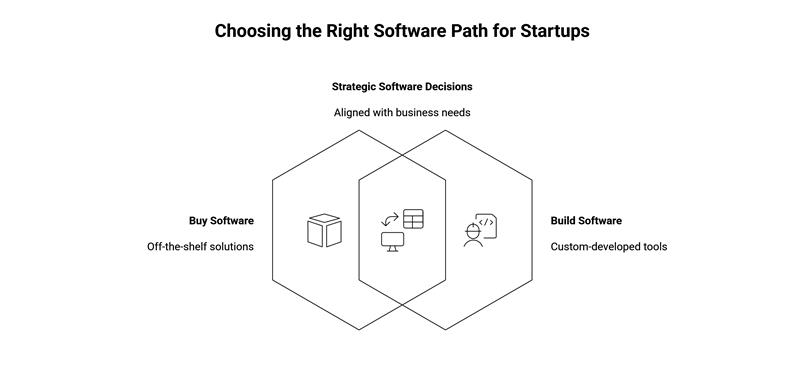
The software build vs buy discussion has evolved for startups. There are still times when it makes sense to buy off-the-shelf tools. For instance, if it is a common workflow, not a specific value, temporary, or not connected to the core company value, then buying a SaaS solution can be time-saving and cost-reducing.
But as companies grow, many founders find that the model is limited. Features bloat: as SaaS tools mature, they frequently add things that we don’t use all the time and aren’t flexible for how we work. This creates a scenario where costs grow as teams scale, integrations become complex, and dependence on third-party vendors creates long-term risk.
Hence, it is always a smarter choice to go for customized software when the software supports a unique process, helps protect intellectual property, or directly influences the revenue and customer experience. Here, bespoke development will be better suited to satisfy business needs and deliver sustainable value.
SaaS vs Custom Software for Startups
They preferred SaaS tools because they were affordable to start and easy to manage. Consequently, startups can iterate quickly in their early stage without technical overhead. But SaaS products are built to serve the masses. For this reason, they are not tailor-made for the logic of one firm.
Custom software, on the other hand, has a different advantage. More specifically, it’s the way the business works now and how it will scale. In addition, proprietary systems allow for more robust workflow automation software, tidier integration, and greater data ownership. Rather than having teams build workarounds to limitations, custom solutions can scale with the business.
So instead, they’re adopting a hybrid approach in 2026: They start by using SaaS for as long as possible and then transition over to homegrown systems as their needs get more complex.
Why Scalability Is Driving Custom Software Adoption
Scalability is among the main motives why startups move towards custom development. Early-stage tools, first of all, work great until growth gets quicker. By then, startups already have performance problems, inflexible workflows, and systems unresponsive to new products or markets.
For that reason, scalable software solutions are adaptable to the company’s growth. In practice, they enable teams to add features and to scale out services while integrating new ones without having to rebuild everything from the ground up. That’s why Chicago founders are coming to understand that investing in scalability early pays off handsomely down the line.
Finally, custom software lets startups plan for growth, not react to it.
Workflow Automation as a Growth Advantage
Startups that want to scale efficiently have made workflow automation software a must-have. Indeed, by 2026, companies will automate onboarding, reporting, approvals, customer communication, and compliance activities.
But commercial automation tools can sometimes force businesses to adjust how they work. In the case of Custom Automation, it’s the opposite process. More specifically, it’s the automation and optimization of what you’re already doing. Therefore, this method cuts down on manual labor and human error, enabling lean teams to work closer to capacity.
Automation, therefore, is a critical force that drives productivity in most Chicago tech startups.
The Cost Reality of Custom Software vs SaaS
One of the most frequent concerns about custom software is, of course, cost. Although an initial investment is needed in custom development, long-term costs are generally quite different. Asteams grow, SaaS subscriptions proliferate, and new tools are added to bridge needs. This, in turn, leads to tool sprawl and unanticipated costs.
For custom solutions, it can mean bundling many subscriptions into one. On a three to five-year horizon, a custom development can appear more cost-effective , particularly if your growth plan for startups is stable.
Founders who look beyond the first year see the financial upside more clearly.
Thinking long-term about your tech stack?
When SaaS costs start adding up, custom development becomes a smarter investment. See how Supreme Technologies works with startups to build scalable, cost-effective software designed for growth.
Security, Compliance, and Data Ownership
Startups are becoming more and more concerned about security and data ownership.” Risks, particularly for businesses holding sensitive customer or financial information, are presented by shared SaaS environments. As such, bespoke software provides startups greater control over access and data storage as well as their obligations to comply with regulations.
That’s why this type of oversight is especially important for Chicago startups with an eye on regulated industries. In the end, custom systems offer greater ability to comply while keeping options open.
When a Startup Should Choose Custom Software
Custom software rises as a viable alternative when you’re doing manual work to grow, feel handcuffed by what SaaS tools allow you to do, integration issues plague and add frequent costs, or the cost of using all these different types of software is increasing with no added value. It also makes sense, of course, when the business model depends on a special workflow or secret process.
Here is a good rule of thumb: if the software IS your business, or plays an important role in the functioning of your business, or how it makes money, then building custom software should be on the table.
Choosing the Right Custom Software Partner in Chicago
The success of a custom software project depends heavily on the development partner. Startups benefit most from teams that understand the Chicago startup ecosystem and can translate business goals into scalable, reliable technical solutions. Clear communication, long-term support, and proven startup experience are essential for building software that grows with the business.
Custom Software Development Services: Key Steps
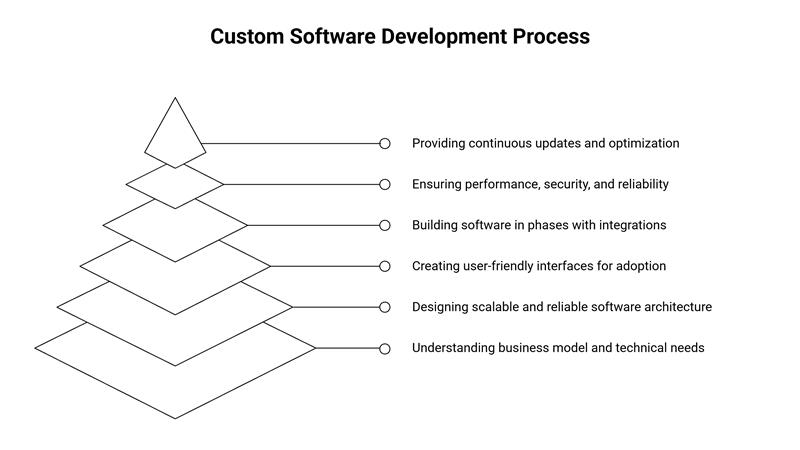
Discovery and Requirement Analysis The process begins by understanding the startup’s business model, workflows, growth plans, and technical needs. This ensures the software is aligned with real operational goals.
Solution Architecture and Planning Based on the requirements, the development team designs a scalable architecture, selects the right technologies, and defines a clear development roadmap.
UI/UX Design User-friendly interfaces are designed to match how teams and customers actually use the software, improving adoption and efficiency.
Development and Integration The software is built in phases, with integrations to existing tools, databases, and third-party services where required.
Testing and Quality Assurance Each feature is tested for performance, security, and reliability to ensure the system works smoothly under real-world conditions.
Deployment and Ongoing Support After launch, continuous support, updates, and optimization help the software evolve as the startup grows.
Also read: Web Development Trends Chicago Businesses Should Follow In 2026
Conclusion
In 2026, custom software development for startups in Chicago is a must as it matches technology with your real business objectives. As such, custom software is flexible, scalable, and can provide long-term value that off-the-shelf tools cannot.
For any founder whose eyes are set on growth, efficiency, and differentiation, custom software is no longer a problem of the future. It is not something to be done only as a last resort, but an offensive move to influence the way a company operates and competes.
Planning Your Next Software Step?
If your startup is outgrowing standard tools or preparing to scale, a custom software approach can create long-term clarity and efficiency. Supreme Technologies works with startups to design software that aligns with real business goals and future growth.
FAQs
Q1. What is the average cost of custom software for startups?
Costs depend on scope and complexity, but many startups begin with small, focused systems rather than full platforms.
Q2. Is custom software only suitable for large startups?
No. In fact, early-stage startups often build targeted custom tools that support growth without heavy investment.
Q3. How long does custom software development take?
Timelines vary, but generally, many initial versions can be delivered within a few months.
Q4. Can startups combine SaaS tools with custom software?
Yes. As a result, many startups use custom software to integrate and extend existing SaaS tools.