
As businesses move deeper into the digital era, automation technologies are becoming increasingly vital for transforming operations. Hyperautomation and Robotic Process Automation (RPA) are leading the charge.
They are reshaping workflows and processes across industries. In 2025, the landscape of business automation is set to evolve even further. The integration of artificial intelligence (AI), machine learning, and intelligent orchestration will play a key role. This article delves into the importance of these technologies. It covers their benefits, emerging trends, and practical applications for businesses seeking to stay competitive in a rapidly changing environment.
What Is Hyperautomation and RPA?
Hyperautomation is the automation of automation. Not to mention, it is not a pure workflow automation either, as there are the ingredients of AI, parallelism, distribution of work, and so on. Hyperautomation eliminates the human touch points and brings end-to-end processes together. Companies can optimize entire processes from start to finish. This results in greater efficiency in operation.
Robotics Process Automation (RPA) is one of the core technologies in hyper automation. RPA uses software bots to automate mundane, rules-based tasks like data entry, form-filling, and system integration. These bots can work 24 hours a day, seven days a week, and they can process jobs more quickly and more accurately than a human. This is why many businesses are interested in streamlining their processes.
So, both of these are foundational future-of-work enablers. They free your organization to focus on higher-value tasks by taking over the mundane.
Benefits of Hyperautomation and RPA
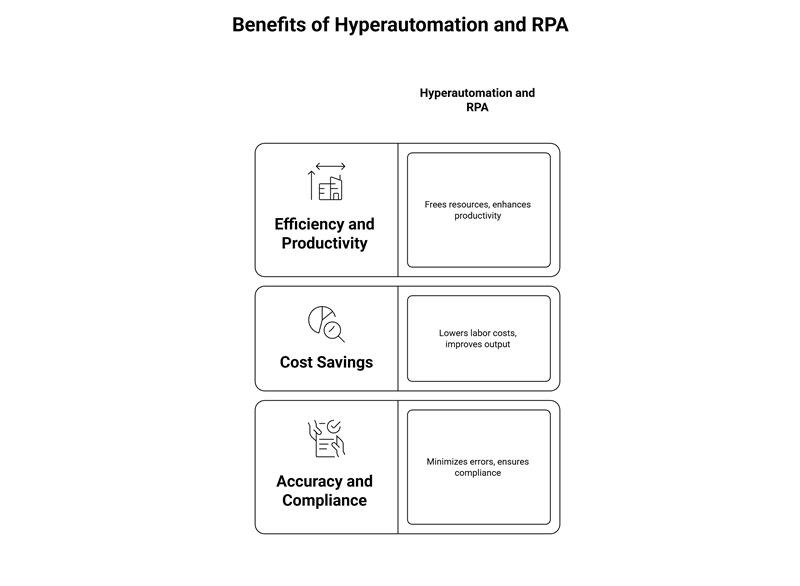
The use of hyperautomation and RPA offers multiple advantages that make operations more effective, flexible, and cost-efficient. For example, these technologies streamline routine processes, improving both speed and accuracy.
Improved Efficiency and Productivity
Automating the mundane not only frees people up to use their time for more strategic work but also improves productivity. RPA bots can relieve the burden of high volumes of mundane work (which requires a minimal amount of decision-making), such as data input or customer inquiries.
This means that people can focus more of their time on decision-making, problem-solving, and innovation. This allows businesses to achieve improved efficiency and expedite their operations.
Cost Savings
With RPA and hyperautomation, companies can lower the cost of labor by automating tasks that are done manually. In fact, industry publications report that companies utilizing automation technology have cut costs in business processes by up to 30-50%. Additionally, RPA’s capacity to work 24/7 without breaks or downtime results in improved output while eliminating the need for corresponding increases in overhead.
Enhanced Accuracy and Compliance
RPA minimizes human error and ensures that tasks are performed with uniform accuracy. Furthermore, through the automation of compliance activities, such as regulatory reporting and data management, companies can be assured that they are complying with required regulations. This minimizes the potential risk of costly errors or non-compliance.
Also read: Designing Secure Distributed Cloud Architectures For Modern Web Applications.
Key Trends in Hyperautomation and RPA for 2025
As we move into 2025, several trends are shaping the future of hyperautomation and RPA:
AI-Powered Automation
AI and machine learning are significantly enhancing the capabilities of RPA. With AI-powered automation, businesses can not only automate repetitive tasks but also make data-driven decisions. AI is enabling RPA systems to handle more complex tasks, such as data analysis and predictive modeling, leading to smarter and more efficient processes.
Automation in Complex Processes
In 2025, we will see hyperautomation extending beyond simple administrative tasks to more complex business processes, such as supply chain management, customer service, and finance. This shift allows businesses to automate even the most sophisticated workflows, improving overall business agility.
Integration with Other Technologies
As businesses adopt cloud computing, IoT, and big data analytics, hyperautomation technologies are integrating seamlessly with these platforms. This integration enables businesses to automate processes that span multiple systems, creating a more unified and efficient operation.
The Role of Artificial Intelligence in Hyperautomation
AI is a fundamental building block of hyperautomation as it adds expansive capabilities to your business processes. Traditional RPA merely automates basic tasks, while AI can inject the power of automation by enabling systems to see into data, observe patterns, and predict trends. That is to say, not just automated, dumb automation, but feeding AI the tools and autonomy to make its own decisions on data insights.
It can help with an even wider range of more complex tasks with cognitive assistance by AI automation. This is all the more interesting when working with unstructured data (content and context-based) and decision-making in real time.
For example, AI can forecast demand patterns so companies are better able to handle inventory and their supply chain. Along with RPA, AI is a force multiplier, automating both mundane tasks and more complex decision-making. It improves the speed, granularity, and effectiveness of business processes.
Practical Applications of Hyperautomation and RPA in Business
In multiple fields, hyperautomation and RPA are used to increase effectiveness, decrease mistakes, and optimize processes.
Finance and Accounting
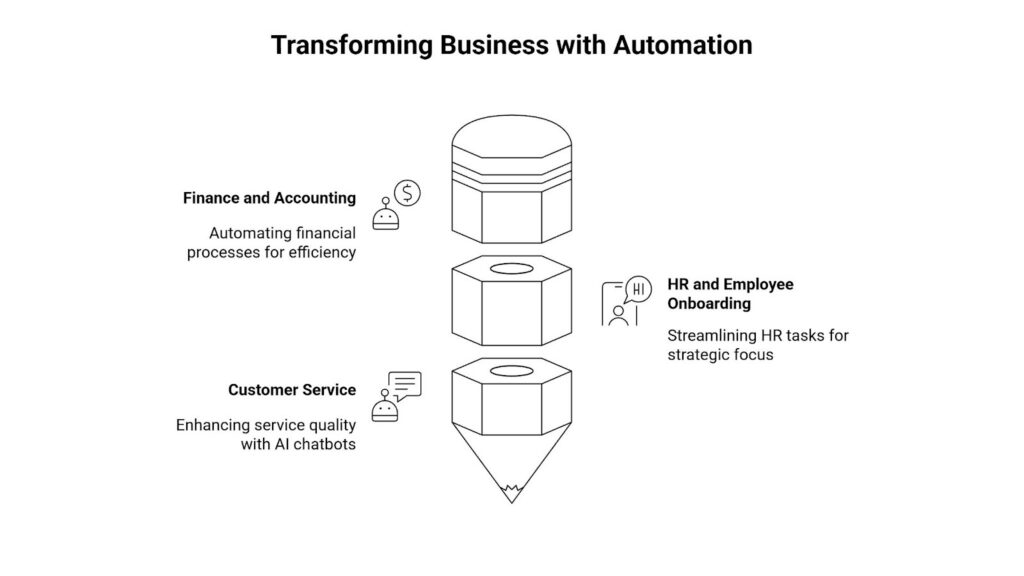
RPA is fundamentally changing the way the finance sector works, automating processes such as invoice processing, reconciliation, and financial reporting. This was previously a time-consuming and manual process, now carried out rapidly and accurately by software bots. This substantially frees up the finance team’s workload while ensuring compliance.
HR and Employee Onboarding
RPA can simplify HR activities, including recruitment, payroll, and employee onboarding. RPA bots can be tasked with candidate screening, document validation, and interview scheduling. This lets HR focus on strategic talent management rather than mundane administrative work.
Customer Service
Service is being automated in big ways. Customer queries can be automated using RPA, including ticketing systems and real-time responses to common questions. An AI-based chatbot can provide highly personalized assistance, increasing customer service quality while decreasing response time.
Adapting to the New Workforce Dynamics
The nature of work will change as automation becomes more advanced. Whereas automation may displace repetitive tasks, it will also spawn new job demands for higher-level skills, critical thinking, and strategic decision-making. For instance, in finance, RPA would allow for the automation of data processing, but not a task where employees interpret arcane data and make crucial business decisions. And AI in customer service can also tackle straightforward inquiries, freeing up human workers to deal with the more complex, emotional, and personalized interactions.
And that means business needs to invest in upskilling their workforces. Workers will need to adjust not only to using AI and automation but also to learning how to work alongside them. This requires education of two sorts: technical training to build these new ergonomic facilities, and training on how to exploit automation for more strategic work. In the end, it’s about building a nimble workforce that can concentrate on high-growth areas of your business and help you stay competitive in an ever-automating world of work.
The Future of Hyperautomation and RPA in 2025
The age of hyperautomation and RPA in 2025 will transform the enterprise. As companies digitize their universe, the importance of scalable and intelligent automation mentalities becomes an ever more vital component. Hyperautomation and RPA are no longer just for Frankensteining tools together; they’re core enablers of enterprise-level digital transformation.
Enterprises will scale these technologies across sophisticated, cross-functional workflows by 2025. They will become leaner and optimized for effectiveness, discipline, and speed. In addition, data science and machine learning algorithms that complement these will not only automate repetitive tasks but also more complex decision support functions. This level of integration makes businesses more responsive to market pressures, allowing operations to run smoothly and improving customer experiences.
In order for businesses to keep up, we will witness an ever-increasing demand to invest in appropriate automation tools and platforms. These answers will have to optimize the capabilities to interlink and scale, while keeping flexibility as markets and consumer demands change.
And then workforce transformation will figure into it as well. This means staff members will need to figure out how to work together alongside bots and AI. While making this transition, all of these companies will have to reskill their employees so that those workers in turn can collaborate effectively with the automation technologies, taking on duties that are less routine and repetitive, duties that demand creativity or strategic thinking, or empathy.
Conclusion
RPA and hyperautomation are the game changers in how companies can get things done. As they mature, it is important to be ahead of these developments in order to remain competitive. By 2025, hyperautomation and RPA utilization will have moderate implications in efficiency gains and cost reductions, with unfavorable impacts on an organization’s ability to bend the workforce curve.
They also free employees from rote work and can even generate entirely new product innovations. They free up people to do more important work. At the end of the day, IDC is the future of business. And those who implement it now can gain a significant advantage over established rivals.
Want to leverage hyperautomation and RPA for your business? Contact Supreme Technologies today to explore how our automation solutions can boost efficiency and drive innovation.