
eCommerce in 2026 is no longer just about selling products online. For this reason, for Dallas businesses, it has become a core business system that directly impacts revenue, customer trust, operational efficiency, and long-term scalability. Customers today expect speed, clarity, and security at every step of the buying journey. As a result, when those expectations are not met, they leave quickly and often do not return.
Consequently, this shift has changed how business owners, founders, CTOs, and IT leaders evaluate eCommerce platforms. The focus is no longer on surface-level features. Instead, attention has moved toward must-have eCommerce features that support real business outcomes such as higher conversion rates, improved customer experience, and sustainable growth.
Therefore, this article explains which eCommerce features Dallas businesses need to prioritize in 2026 and why those features matter from a business perspective, not just a technical one.
Why eCommerce Requirements Are Changing for Dallas Businesses in 2026
Dallas is thriving as a formidable business and tech community, home to companies of all industries, including retail, services, and B2B commerce. As a result, as the industry expands, so do customer expectations and competition. Purchasers are comparing online experiences across industries and geographies, no longer just within their local market.
At the same time, mobile-first shopping is the new normal, security requirements have been heightened, and customers demand faster, easier purchasing experiences. But companies also must have eCommerce platforms that can enable growth, but do not require rebuilding and the strain of operating.
But traditional eCommerce platforms aren’t always up to the task. They drag down teams, irritate customers, and constrain a company’s ability to grow. That’s why certain eCommerce features that used to be optional are now necessary if a company wants to remain competitive.
What “Must-Have eCommerce Features” Really Mean in 2026
In 2026, the defining factor for essential eCommerce features will be their impact rather than their novelty. That’s because these traits have a direct impact on how well an organisation can find, extract, and keep customers while optimising their processes in the background.
Furthermore, a good “must have” also accelerates fund productivity, adds to credibility, drives growth, or reduces friction for customers and internal forces. Functionality that doesn’t further these results adds complexity with no discernible value.
In the end, if you are a business in Dallas looking to succeed over the long haul, it’s not about adding every feature possible but rather investing in tools that coincide with your other goals and those of your customers.
Core eCommerce Features Every Dallas Business Should Prioritize

Mobile-Friendly eCommerce Experiences (One of the Must-Have eCommerce Features)
Mobile-friendly eCommerce is no longer optional. In fact, a significant portion of eCommerce traffic now comes from mobile devices, and customers expect a seamless experience regardless of screen size. Mobile optimization goes beyond responsive design. Instead, it involves fast load times, simplified navigation, clear product displays, and checkout flows designed specifically for touch interactions.
As a result, businesses that prioritize mobile-friendly eCommerce consistently see better engagement and higher conversion rates. From a strategic standpoint, strong mobile performance reduces bounce rates and ensures that marketing efforts translate into actual revenue rather than lost traffic.
Secure Checkout Features That Build Customer Trust (Must-Have eCommerce Features for 2026)
Secure checkout features play a critical role in customer decision-making. Notably, modern buyers are highly aware of data privacy and payment security. If a checkout process feels unsafe or unclear, customers are unlikely to complete their purchase.
Additionally, security measures such as encryption, compliant payment processing, fraud prevention, and visible trust indicators help reassure buyers during the most sensitive stage of the transaction. For businesses, strong security reduces fraud risk, minimizes chargebacks, and protects brand reputation.
Therefore, in 2026, security is not just a technical requirement. It is a trust-building mechanism that directly affects conversion rates.
Flexible Online Payment Solutions for Businesses as Must-Have eCommerce Features
Customer expectations around payments have expanded significantly. As a result, online payment solutions for businesses must support multiple payment methods to accommodate different customer preferences and buying behaviors. This includes traditional cards, digital wallets, and alternative payment options.
Furthermore, providing flexible payment choices reduces friction at checkout and increases the likelihood that customers will complete their purchase. It also supports B2B transactions and cross-border sales, which are becoming more common for Dallas-based companies looking to expand beyond their local market.
Scalable Online Store Functionality Among Must-Have eCommerce Features
Scalability is one of the most important yet overlooked aspects of online store functionality. For this reason, an eCommerce platform should support growth in traffic, product volume, and transaction complexity without requiring constant redesign or replacement.
Consequently, scalable systems allow businesses to add new products, manage inventory efficiently, adjust pricing strategies, and expand sales channels with minimal disruption. From a business standpoint, this reduces long-term costs and protects the initial investment in eCommerce infrastructure.
Also read: Why Chicago Startups Are Choosing Custom Software In 2026
Advanced eCommerce Features That Drive Competitive Advantage
Mobile-Friendly eCommerce Experiences (One of the Must-Have eCommerce Features)
Mobile-friendly eCommerce is no longer optional. In fact, a significant portion of eCommerce traffic now comes from mobile devices, and customers expect a seamless experience regardless of screen size. Mobile optimization goes beyond responsive design. Instead, it involves fast load times, simplified navigation, clear product displays, and checkout flows designed specifically for touch interactions.
As a result, businesses that prioritize mobile-friendly eCommerce consistently see better engagement and higher conversion rates. From a strategic standpoint, strong mobile performance reduces bounce rates and ensures that marketing efforts translate into actual revenue rather than lost traffic.
Secure Checkout Features That Build Customer Trust (Must-Have eCommerce Features for 2026)
Secure checkout features play a critical role in customer decision-making. Notably, modern buyers are highly aware of data privacy and payment security. If a checkout process feels unsafe or unclear, customers are unlikely to complete their purchase.
Additionally, security measures such as encryption, compliant payment processing, fraud prevention, and visible trust indicators help reassure buyers during the most sensitive stage of the transaction. For businesses, strong security reduces fraud risk, minimizes chargebacks, and protects brand reputation.
Therefore, in 2026, security is not just a technical requirement. It is a trust-building mechanism that directly affects conversion rates.
Flexible Online Payment Solutions for Businesses as Must-Have eCommerce Features
Customer expectations around payments have expanded significantly. As a result, online payment solutions for businesses must support multiple payment methods to accommodate different customer preferences and buying behaviors. This includes traditional cards, digital wallets, and alternative payment options.
Furthermore, providing flexible payment choices reduces friction at checkout and increases the likelihood that customers will complete their purchase. It also supports B2B transactions and cross-border sales, which are becoming more common for Dallas-based companies looking to expand beyond their local market.
Scalable Online Store Functionality Among Must-Have eCommerce Features
Scalability is one of the most important yet overlooked aspects of online store functionality. For this reason, an eCommerce platform should support growth in traffic, product volume, and transaction complexity without requiring constant redesign or replacement.
Consequently, scalable systems allow businesses to add new products, manage inventory efficiently, adjust pricing strategies, and expand sales channels with minimal disruption. From a business standpoint, this reduces long-term costs and protects the initial investment in eCommerce infrastructure.
Also read: Why Chicago Startups Are Choosing Custom Software In 2026
Advanced eCommerce Features That Drive Competitive Advantage
Optimized eCommerce User Experience Across Touchpoints
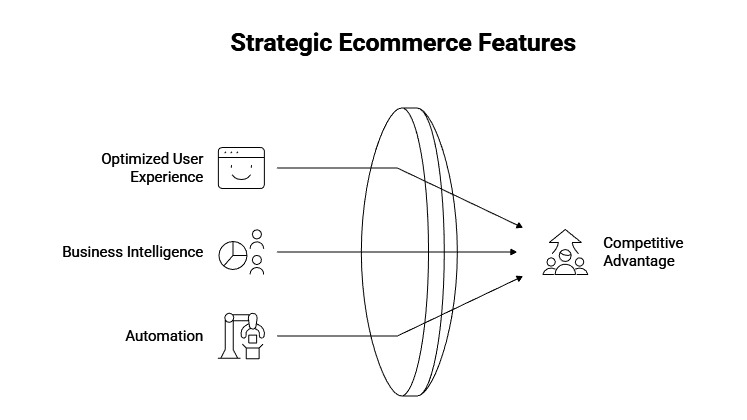
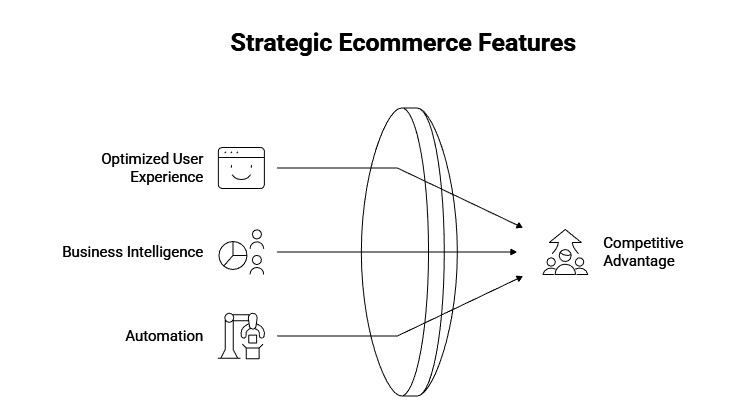
eCommerce UX impacts how users perceive a brand and whether they come back. It’s worth noting that UX isn’t just a fancy term for visual design. Navigation clarity, page load time, available product information, and ease of checkout.
Because of that, a beautifully optimized user experience for eCommerce eliminates clutter, streamlines the buying process, and instills confidence in the customer. And companies committed to UX typically have higher repeat purchase rates and lower support costs because users can find what they need without help.
Business Intelligence and Analytics Integration
Analytics can turn an eCommerce platform into a decision-support system. In particular, integrated reporting makes it possible for businesses to determine how their customers behave, track trends in performance, and measure the impact of marketing and operations strategies.
As time goes by, this data is used to enable decision-making around inventory planning, pricing adjustments, and customer experience enhancements by a leadership team. Data-driven insights enable more consistent growth and superior resource allocation.
Automation Features That Improve Operational Efficiency
Automation enables scaling up (and out) with less manual work and operational bottlenecks. In reality, that means eCommerce systems that handle order flow and fulfillment, inventory updates with the warehouse, customer service queries like refunding an order paid for using a rewards program or sending replacement items (they’ll be on their way soon), and report generating so humans can think.
For Dallas businesses experiencing growth, automation provides consistency, reduces errors, and cuts operating expenses. When you are processing more, and customers demand even faster delivery, the impact of these efficiencies becomes all the more pronounced.
eCommerce Tools for Small Businesses vs Enterprise Platforms
Enterprise-level eCommerce platforms aren’t right for every business. Rather than complexity, the best small business eCommerce software should focus on providing reliable, user-friendly, and scalable solutions. Implementation hurdles: One downside is obviously the implementation speed, but the others are more about your system’s complexity (onboarding delay) and maintainability.
Apparently, then the best is to select a platform that you need now and one that would cater to realistic future expansions. This balance will ensure that companies won’t be limited by tech when they grow.
How the Right eCommerce Features Support Long-Term Business Growth
When eCommerce capabilities are designed in support of business goals, they do more than just drive near-term sales. They were adopted in order to ensure a unified customer experience on the operational side and inform decision-making based on data.
When businesses invest in the right eCommerce capabilities, over time, they achieve better customer retention and ultimately more profitability for greater agility to respond to market changes. eCommerce is an engine of growth, not a tech problem.
Common Mistakes Dallas Businesses Make When Choosing eCommerce Features
Too many eCommerce projects collapse because companies follow trends instead of logic. For example, such problems can include over-designing while overlooking system performance capacity, failing to consider and plan for security constraints in a meaningful manner, and selecting platforms that are not cost-effective or do not scale well.
Another common error is a tendency to buy tools without taking into account how they are going to be maintained and the cost of operation. Businesses change, and your eCommerce platform should grow along, not lead to overhauls.
How to Evaluate eCommerce Features Before You Invest
Before selecting an eCommerce platform, decision-makers should consider how each feature will help them achieve their business objectives. This consists of evaluating scalability, security, usability, and integration potential.
Therefore, objective evaluation criteria will also avoid costly errors and ensure that investments in eCommerce generate sustainable results, rather than mere ephemeral exemption from the pains of change.
Conclusion
In 2026, simply being online will not be enough to ensure profitable eCommerce. Its basic store building functionality is not enough. It needs essential eCommerce features to ensure trust, performance, and scalability. Dallas businesses that embrace mobile-friendly eCommerce, robust checkout features, great user experience, and flexible payment methods will have a competitive advantage to compete and grow.
The reality is that the best eCommerce strategies focus on clarity, understanding customer wants, and achieving longer-term goals. When the features contribute to business objectives, the eCommerce system is a cornerstone for growth.
Take the Next Step Toward Ecommerce Growth
Don’t let outdated systems hold your business back. Collaborate with Supreme Technologies to design and deploy strategic eCommerce features that drive conversions, enhance user experience, and support long-term scalability. Schedule a discovery call at Supremetechnologies today.