
AI-Driven Hyper-Personalization in Digital Marketing

AI Hyper Personalization

The digital landscape is becoming more competitive each year, and customers now expect every interaction to feel personal, relevant, and timely. Moreover, AI hyper-personalization is the next major evolution in marketing. It moves far beyond traditional personalization, where businesses relied on simple rules like using a customer’s name or sending general product recommendations.

Hyper-personalization uses real-time data, machine learning, and predictive insights to deliver experiences that feel tailor-made for each user. Businesses that adopt this approach are already seeing stronger engagement, improved retention, and higher return on marketing investments. Additionally, in a world where attention spans are short, AI-powered personalization helps brands communicate with precision and relevance.

How AI hyper-personalization Works

AI hyper-personalization works by gathering data from multiple touchpoints and analyzing it to understand user behavior, context, preferences, and intent. Furthermore, rather than using static segments, AI studies patterns in real time to determine what a customer wants at any moment. It processes browsing history, purchase behavior, engagement signals, demographic data, and contextual information to deliver the right message at the right time.

Machine learning algorithms make predictions, refine recommendations, and adjust user experiences instantly. Consequently, when a customer visits a website or interacts with a mobile app, AI can change content, offers, and recommendations within seconds. This level of responsiveness is not possible with manual marketing processes. It helps businesses deliver experiences that feel natural and intuitive.

Why AI-Powered Personalization Matters for Businesses Today

Customer expectations have changed dramatically. According to a survey by McKinsey, 71% of consumers feel frustrated when their shopping experience is impersonal, and 76% will switch brands if they’re treated like a number. Customers are open to sharing personal data if it will result in more-relevant experiences, Salesforce finds. These are the indications that personalization powered by AI is necessary. AI-powered personalization businesses achieve a competitive advantage in that each interaction is increasingly more relevant and meaningful. This relevance to date converts well and develops strong loyalty. Therefore, businesses that embrace this shift often see sustained long-term growth.

According to Deloitte, businesses with advanced personalization have 20% more sales, while Gartner says organizations leveraging AI personalization will outsell those who don’t by more than 30% in customer satisfaction ratings. With the rise of digital competition, businesses that do not personalize will have a difficult time standing out and remaining relevant.

AI Customer Segmentation for Smarter Marketing

Traditional segmentation divides users into big categories like age or location, or considers purchasing history. These clips are hardly an accurate representation of what people are up to, in thought or deed. AI-based customer segmentation is much more expressive and intelligent. It looks at billions of data points to generate micro-segments that represent specific behaviors and immediate expressions.

For instance, AI can tell if a user is price sensitive, quality conscious, or looking to browse for specific categories long before they add something to the cart. Personalization through machine learning. New actions or changes in behavior continuously update these segments. and the weights for every user. Consequently, it makes marketing campaigns more germane and ads, emails, and recommendations more precise. Moreover, this continuous refinement helps brands stay aligned with fast-changing customer intent.

Real Time Personalization and Predictive Experiences

The insights haven’t typically been used to inform “real-time” personalization, or a customer’s experience that changes on the spot based on what he or she is doing. However, a visitor shopping for winter clothes might be shown seasonal deals or popular products. If you slow up at a checkout page, you might get an email or a message telling you to finish your purchase.

Predictive personalization moves beyond analyzing trends and predicts what the customer will do next. For instance, an AI engine can always determine when a user is due for an upgrade, when they will require help or support, and eventually when they are likely to churn. Consequently, these are forward-looking predictions that allow companies to take steps in advance rather than wait and react. This readiness increases conversions and safeguards the relationships with customers.

The Role of Machine Learning in Personalization

Hyper-personalization is driven by machine learning. Supervised learning allows A.I. to recognize established patterns, which products are often bought together. Additionally, unsupervised learning allows systems to learn new patterns without needing to be told what specifically to search for. Reinforcement learning is like trial and error, where one learns from immediate feedback. These models learn from each interaction, so the more data a system collects, the more accurate it becomes at personalization.

Machine learning personalization can also be adjusted seasonally, based on trends and across customer journeys, so it’s a strategy that becomes more effective and relevant over time, evolving with the business. Therefore, this flexibility means organizations can trust that their personalization system will evolve without any manual input.

AI-Powered Customer Experiences Across Channels

Customers often switch between different channels, such as websites, mobile apps, chatbots, social media, email, and online ads. If this experience is not cohesive across these channels, engagement suffers. Hyper-personalization through AI allows companies to provide frictionless, connected experiences from one channel to the next. A person who is browsing a category in a mobile app, for example, would see related recommendations on email or ads.

A chatbot can provide tailored support by leveraging previous interactions. Product recommendations are more targeted, content is better attuned to the user’s purpose, and messaging has a stronger resonance. This omnichannel approach allows businesses to continue to engage customers and establish a level of trust. Businesses with consistent personalized customer experiences across channels have dramatically higher satisfaction scores. Furthermore, this consistency strengthens overall brand perception.

Also read: App Development Cost In 2025: Complete Breakdown, Pricing Factors & Real Estimates

Benefits of AI-Driven Hyper Personalization for Enterprises

AI-powered hyper-personalization brings quantifiable value to every stage of the customer journey. It increases conversions by helping users find the products and content they are most likely to be interested in. It helps customer retention as the brand ‘feels’ more attentive and user-centric. Moreover, it lowers acquisition costs as marketing becomes more precise and effective. Additionally, Per Epsilon, personalized experience can improve customer loyalty as much as forty-four percent.

Companies that leverage AI for personalization also see increased engagement, longer session times, and higher revenue per visitor. As a result, for businesses with a lot of customers, AI can represent an alternative to having humans carry out repetitive tasks, making decisions at scale in real time so that your marketing and content production team have time to take the initiative and innovate. Consequently, this creates more efficient workflows and stronger overall performance.

Challenges and Ethical Considerations

While there are overall benefits to AI personalization, the implementation of this practice must be responsible. Privacy is an issue, and users should be informed about how they are being tracked. Additionally, customers are going to need to know what data is being used, and for the benefit of whom.

Strict compliance with GDPR, CCPA, as well as other data protection regulations is a must. Responsible AI design involves preventing biased algorithms, ensuring fairness, and safeguarding privacy. Transparent consent and secure data processing build trust between consumers and brands. Consequently, customers are comfortable with nothing personal with brands that responsibly personalize.

Implementing AI-Driven Hyper Personalization in Your Business

The road to AI personalization starts with examining the quality of your existing data and identifying holes in it. Then, companies combine AI tools with their CRM platform, marketing stacks, and product databases. The data pipeline has to be clean, available, and predictable. Next, employ machine learning models aligned with business goals and shopping behaviors. Testing is a must to understand user reactions and deliver better strategies. Afterward, companies can fine-tune models to ensure each personalization layer delivers measurable improvement.

As the results are being reported, businesses can extend personalization to new touchpoints. Immediate widespread implementation is not necessitated by the process. Businesses can start with baby steps like personalized recommendations or dynamic emails and build their competence to take on the giant task of implementing real-time omnichannel personalization. With such guidance, the execution is easier and more effective.

Services Supreme Technologies Offers

We at Supreme Technologies support businesses at every stage of digital transformation. Organizations exploring AI hyper-personalization can learn more through our custom software development services. Companies seeking AI model development, machine learning solutions, or data-driven personalization strategies can visit the dedicated AI and ML development section on the website. 

Businesses that require custom CRM integration, targeted digital marketing campaigns, mobile or web application development, and enterprise IT solutions can explore our service offerings in detail. We designed each service to help organizations build intelligent systems, streamline workflows, and deliver personalized customer experiences that lead to stronger business outcomes.

Conclusion

AI-Powered Hyper-Personalization is revolutionizing how industries do digital marketing and customer experience. It enables companies to speak with clarity and precision, build memorable user flows, and improve engagement & conversion. Moreover, with heightened customer expectations, businesses that leverage AI personalization can grow, scale, and win.

The future of marketing is about companies that listen to, understand , and converse on a human level with their customers. Ultimately, AI is the intelligence and speed we need to accomplish this.

Ready to bring AI hyper-personalization into your business?

Our team at Supreme Technologies can help you build intelligent, data-driven systems that create meaningful customer experiences. Reach out today and let’s start transforming your digital strategy.

FAQs

1. What is AI hyper-personalization?

AI hyper-personalization uses real-time data, machine learning, and predictive analytics to deliver highly relevant and individualized customer experiences across digital channels.

2. How does AI customer segmentation work?

AI segmentation analyzes millions of data points to create precise user groups based on behavior, intent, and context. These segments update automatically as users interact with the brand.

3. Is real-time personalization difficult to implement?

Businesses can start with small implementations, such as product recommendations or dynamic emails, and gradually scale to full real-time personalization as their systems mature.

4. Does personalization violate data privacy?

Responsible AI implementation requires transparency, consent, and compliance with data protection laws. When handled correctly, personalization improves customer trust.

5. How can Supreme Technologies help?

Supreme Technologies provides AI development, digital marketing, CRM integration, and enterprise IT services that help businesses implement AI-driven personalization at scale.
App Development Cost in 2025: Complete Breakdown, Pricing Factors & Real Estimates

App Development Cost

Business owners plan their digital strategy with a sharper focus in 2025. The mobile and web application market grows rapidly because consumers expect faster, more personalized, and more secure digital experiences. The cost to develop an app changes because new technologies evolve, user expectations rise, and teams adopt modern development practices. Meanwhile, understanding the complete app development cost helps leaders plan budgets, avoid delays, and invest confidently.

Decision makers cannot rely on outdated pricing. Artificial intelligence, automation, cloud infrastructure, and real-time features influence the overall budget. Therefore, this article explains the complete app development cost with verified insights, credible data, and real numbers that help you understand what you should expect before you hire a development team.

What Determines the App Development Cost in 2025

Your app development cost is determined by the level of complexity, features you need, technology stack, design depth, and compatibility standards, as well as the experience of the developer or development team. The price shifts because simple apps have fewer screens and functionalities. Moderate applications employ APIs, secure logins, dashboards, and cloud storage. Complex applications can have payment processing, AI-powered features, real-time chat, geolocation, or automation. The platform matters too in this respect. In iOS development, it’s Swift, Android uses Kotlin, and cross-platform uses Flutter or React Native. These decisions have implications for the timing of development and price.

Location also matters. They’re also more expensive in North America and Western Europe compared to Eastern Europe or Asia. The spectrum introduces cost variations even between similar projects. Experienced teams are more expensive, but the cost is worthwhile over time, as they write cleaner code and save you money down the road by streamlining rework.

Average Cost to Develop an App in 2025

The average cost to develop an app in 2025 depends on complexity. Simple applications cost between 25,000 USD and 45,000 USD. Moderate complexity apps cost between 45,000 USD and 120,000 USD. Highly advanced apps with artificial intelligence, automation, high security, or real-time features cost between 120,000 USD and 350,000 USD or more.

A 2024 Accelerance global development report confirms that hourly rates vary between 25 USD and 250 USD, depending on geography and skill level. These numbers create large variations in the final app budget. The estimate becomes more precise when you define platforms, features, tech stack, and development goals.

Mobile App Development Cost Breakdown by Platform

Android app development cost. The average cost of Android app development is on the higher side, as devices need to be tested across different screen sizes. Apps tend to be a little cheaper to develop for iOS because of a smaller device ecosystem. However, cross-platform development solves this challenge. And since the same code can be used for both platforms, overall budgets are lower.”

A native build for Android or iOS drives up costs because developers have to build for each platform. A build of that in Flutter or React Native can decrease the timeline by 30% – 40%. This is what directly affects the price for app development. Moreover, for a lot of business owners, cross-platform development allows you to obtain faster results with a coherent user experience for all devices.

Web App Development Cost in 2025

Web app development cost depends on the complexity of frontend design, backend logic, server architecture, database requirements, and integration with third-party services. A simple web app ranges between 20,000 USD and 40,000 USD. A mid-sized platform with dashboards, user roles, and workflows ranges between 40,000 USD and 120,000 USD. A highly complex SaaS product ranges above 150,000 USD.

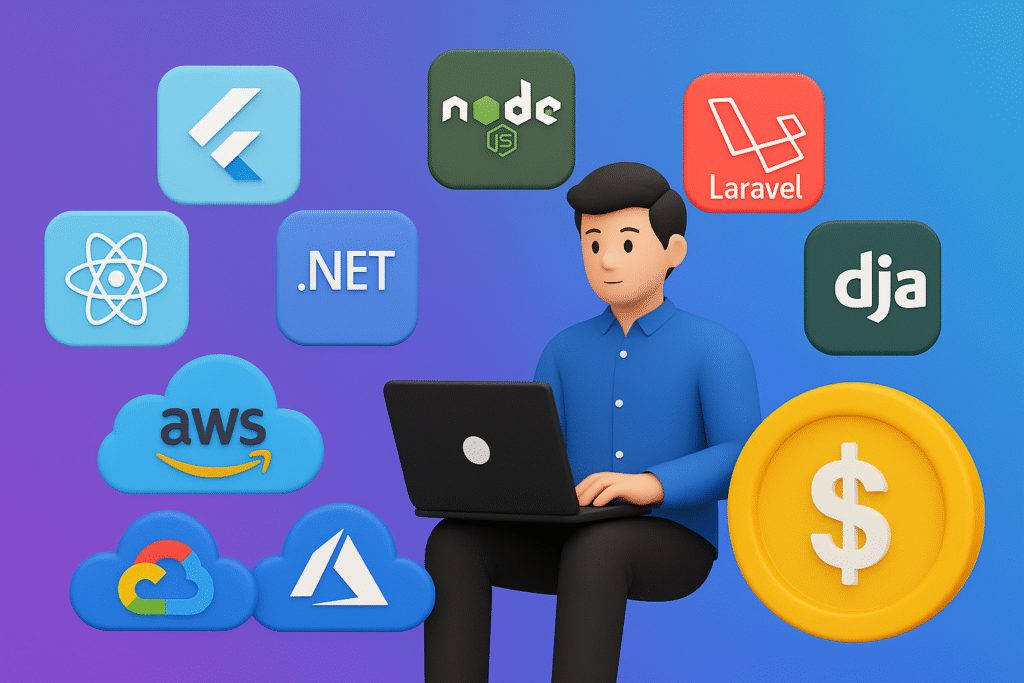
A web app requires a scalable backend. Businesses use Node.js, Laravel, Django, or .NET, depending on performance requirements. Cloud hosting also affects cost. AWS, Google Cloud, and Azure pricing vary based on traffic, storage, load balancing, and security. These factors create additional recurring expenses that business owners must plan for.

App Development Cost Breakdown by Features

In aggregate, such a feature will increase the budget as it adds design, development , and testing time. Authorisation involves safe login, password encryption, two-factor authentication, and identity management. An integration payment gateway is necessary to be PCI DSS compliant. Real-time chat must have WebSocket or Firebase. You want AI features? You get APIs or you train a custom model. GPS, but naturally, you need to have maps and geolocation Map Apps. They all affect the cost of developing an app.

Things like video calling, analytics tools, subscription systems, delivery tracking tools, translation services, multi-vendor capabilities (like Etsy), stock management, and loyalty programs add complexity. The more you can do with your app, the more you need to develop. This results in immediate modification to the cost estimation.

Also read: How Agentic AI Is Transforming Web and App Development in 2026

Industry-Wise App Development Cost Estimates

Ecommerce app development cost ranges between 40,000 USD and 250,000 USD, depending on product catalog size, order management, payment integrations, and inventory logic. Food delivery app development cost ranges between 60,000 USD and 300,000 USD because it requires three panels for customers, restaurants, and delivery partners. Fintech app development cost ranges between 80,000 USD and 400,000 USD because you need strong encryption, compliance, and secure financial data handling.

Healthcare applications require HIPAA compliance and secure patient data handling. Logistics apps require route optimization, fleet tracking, and operational dashboards. SaaS platforms require multi-tenant architecture. Each industry includes compliance requirements and technical depth that increase custom app development.

Technology Stack and Its Impact on Custom App Development Cost

The tech stack you choose makes a big difference in terms of development speed, security, scalability, and ultimately costs. Native Android or iOS will be more expensive to build because you have to build for each platform separately. 

Additionally, Flutter and React Native save cost as a single codebase complies with both platforms. Backend technology influences long-term performance. Node. JS is ideal for applications that require real-time features. Laravel is a framework that gives room for innovations with good structure, fast development. Django is perfect for big data ops.NET just works in an enterprise ecosystem. The technology you select plays an important role in defining your custom app development cost.

Furthermore, Cloud infrastructure also affects cost. The pricing uses a net system where CPU usage, traffic, storage, content delivery networks, and server load are subject to pricing. Organizations will need to account for the cost associated with Serverless, Backup automation & CI/CD pipelines. Good architecture is safer and less expensive in the long run.

You can also explore how our team at Supreme Technologies builds scalable, secure, and high-performance applications across modern tech stacks.

How Much Does It Cost to Hire an App Developer or Team in 2025

Hiring costs vary greatly by region. However, according to Glassdoor, the average annual salary for a mobile app developer in the United States exceeded 110,000 USD in 2024. In India, senior mobile developers averaged 20,000 USD to 35,000 USD per year. Agencies, freelancers, and full-time hires follow different pricing models. Agencies charge higher rates because they include UI designers, project managers, quality testers, and solution architects. Freelancers charge lower rates but require active management.

Hourly rates influence the final app development cost. North America ranges between 100 USD and 250 USD. Western Europe ranges between 70 USD and 180 USD. Eastern Europe ranges between 35 USD and 80 USD. Asia ranges between 20 USD and 50 USD. Moreover, choosing a skilled team determines quality, timeline, and the success of the final product.

App Maintenance, Hosting, and Post-Launch Costs

Maintenance includes bug fixes, security updates, server optimization, version upgrades, and new features. Hosting includes cloud servers, storage, traffic management, and monitoring tools. After launch, apps require continuous improvements because user behavior changes and each operating system updates frequently. 

Therefore, typical maintenance costs reach around 20 percent of the initial development cost per year. A 100,000 USD app usually requires around 15,000 USD to 25,000 USD annually for maintenance, hosting, analytics, and customer support. Furthermore, these ongoing expenses ensure long-term stability and performance.

Hidden Costs Most Businesses Miss

Many enterprises ignore additional costs associated with infrastructure, testing, compliance, and analytics. However, fees on the App Store and Play Store still apply. Apple’s One costs $99 a year. There is a one-off registration fee of 25 USD (or its equivalent in your currency) to upload an application to Google Play.

Cloud hosting, third-party integrations (SMS notifications, map usage, and analytics tools) have pay-as-you-go billing. Multi-device testing will take considerable additional hours with QA testing. Standards and compliance in finance, healthcare, and education can also add expense. Additionally, these charges are capable of affecting the actual app development price more than a majority of businesses expect it to be.

How To Reduce App Development Cost Without Affecting Quality

You can further reduce app development costs by choosing cross-platform development, focusing on core features, launching an MVP first, using ready-made modules, avoiding scope changes, and preparing clear documentation. Moreover, cross-platform apps cut development time significantly. MVP launches help teams validate user feedback early, so you build only what truly matters.

Using ready modules saves you from unnecessary custom coding, and additionally, clear documentation keeps everyone aligned, preventing misunderstandings that often lead to additional expenses. These methods help organizations control the final budget while still delivering strong performance and long-term quality.

Realistic App Development Cost Estimates for 2025

Simple Appointment Booking App: 25,000 USD to 45,000 USD. The development cost of a food delivery marketplace may range from 60k to 300k USD if it includes tracking and managing modules. A fintech wallet costs from 100,000 to 400,000 USD, considering the verification and security modules. 

However, for a SaaS dashboard, you need to pay 50-200k USD or more, depending on how much automation, analytics, and multi-user roles your app will include. Additionally, these estimates inform business owners of what they can or cannot expect before they decide to build their apps in 2025.

Conclusion

App Development Cost in 2025. It will all depend on the complexity of features, platform choice, security needs if the infrastructure should go for, and experience in your app development team. It’s no secret that knowing exactly what goes into the cost of a product makes it far easier to budget for.

Smart planning, feature prioritization, and selecting the right partner will cut development time and long-term costs. A solid app turns into an investment that drives growth and competitive advantage for decades.

Ready to estimate your app development cost with clarity?

Connect with Supreme Technologies for a personalized project analysis and get a detailed cost breakdown tailored to your business goals.

Generative Engine Optimization: How to Rank in AI‑Generated Search Results?

Generative Engine Optimization

The search landscape is going through a seismic shift as AI-powered platforms such as ChatGPT, Gemini, Google’s AI overview, Perplexity, etc, transform how people search for queries. Nowadays, traditional SEO is not enough; there is a Generative Engine Optimisation (GEO), which emerged as an important framework that ensures your content appears in AI-generated search results.

In this blog, we will explain the jargon surrounding GEO, explain its terms and what things you need to do to rank on top in AI-driven search through effective AI search optimization and generative search strategies.

So, let’s get started!

Understand Generative Engine Optimisation

GEO, or Generative Engine Optimisation, refers to the emerging practice of optimising content for AI answers to rank highly in AI large language model outputs, including but not limited to ChatGPT, Claude, Perplexity, as well as all other AI search tools. It’s essentially the next evolution of SEO, but for AI engines rather than traditional search engines; a true AI-first SEO strategy.

What Makes GEO Different from SEO?

While SEO focuses on ranking in Google’s blue links, GEO is about getting your content cited, referenced, or synthesised into the AI-generated answers that increasingly appear at the top of search results or within the AI chat interfaces. As more people use AI tools to find information through large language model referrals, being a part of these AI-generated responses becomes crucial for AI content discoverability and visibility.

Why GEO Matters Now?

AI search is rapidly disrupting how people find their information. Tools such as Google’s AI Overviews, Perplexity, ChatGPT’s search feature, and Bing’s AI Chat are now synthesising information from multiple sources into single responses. The AI overviews’ impact is important, and if your content isn’t optimised for these systems using AI search engine optimization techniques, you could become invisible, even if you have strong traditional SEO. This is why knowing AI search ranking factors is now critical for maintaining visibility.

Core Principles of Generative Engine Optimisation

Clarity and structure are key. AI models like content that’s well-organised, with clear hierarchies, headings, and logical flow. Think of writing to AI models as writing to the most literal reader who appreciates precision.

More performant is the authoritative and cited information. Including sources, data, statistics, and expert quotes makes your content more likely to be trusted and referenced by AI systems, improving AI-generated result visibility.

Thorough coverage trumps superficial content. AI engines more often pull from sources that deeply cover topics with nuance and substance than thin, keyword-stuffed pages. This is essential for ranking in AI summaries.

The instructions by natural language and question-answer formats meet the way that people query information from AI. Content framed around common questions seems more frequently pulled into AI responses, making content optimization for LLMs a crucial practice.

How Generative Engines Work?

As we discussed above, what GEO is, its core principles and generative search strategies, now it’s time to know about how it actually works: 

Well, generative models use huge datasets to create responses as per the users’ entered prompts. They do not rank content traditionally but prioritise the most relevant, credible and valid data.

Let me give you an example:

If you ask ChatGPT, like one of the best shoes for trekking, it will give you content that contains direct product comparisons. Please review the image below:

Despite using keyword density or backlinks, generative AI models focus on contextual relevance, user intent and the ability to complete the user’s questions through semantic SEO for AI engines. The way AI evaluate content is very different from normal search engines like Google.

Furthermore, if I ask ChatGPT more questions about the sole and durability before purchasing trekking shoes, it will use this context to provide more tailored recommendations:

Moreover, if you follow up with additional questions about aspects such as sole durability before deciding on trekking shoes, ChatGPT will use this context to provide a more tailored response.

The Key Difference – GEO vs SEO

SEO, AI Overviews, and GEO are three terms dominating conversations about organic search, but they’re not interchangeable. Each has distinct goals and requires different tactics.

SEO (Search Engine Optimisation) is what we’ve been doing for years—making sure your content shows up when people search Google. You want those top spots on the results page.

AI Overviews (what Google used to call SGE) are those summaries that now appear at the top of search results. They pull bits from different websites and give searchers a quick answer without clicking anything to zero-click AI traffic challenges.

GEO (Generative Engine Optimization) is the new kid on the block. It’s about getting your content referenced when someone asks ChatGPT, Claude, or Perplexity a question. You’re not chasing rankings here—you want to be the source these AI tools actually cite and trust through entity-based SEO for AI search.

Where GEO and SEO Overlap?

Both are chasing the same basic goal: get your content seen. Doesn’t matter if that’s on Google’s first page or in an AI’s response—visibility is visibility.

  • Good content wins in both worlds. If what you’re writing is shallow, outdated, or unreliable, neither Google nor AI systems will give you the time of day. Quality isn’t optional.
  • Keywords still count. Yes, even for GEO. You need to use the terms and phrases people actually search for and ask about. This hasn’t changed.
  • Technical stuff matters everywhere. Your site needs to load fast, have clean code, use proper headings, and include structured data. AI tools crawl the web just like search engines do, so technical hygiene helps both.
  • Links haven’t died. Backlinks from reputable sites tell both Google and AI systems that you know what you’re talking about. Authority still comes from who’s linking to you.

Where GEO Breaks Away from SEO?

The biggest split? What happens after someone finds you?

With SEO, you’re trying to get the click. Your title needs to grab attention. Your meta description needs to make people curious enough to visit. Traffic to your site is the whole point.

With GEO, the AI might answer the question completely using your content, and the searcher never visits your site at all. You get cited, maybe you get brand awareness, but you might not get the visitor. It’s a weird trade-off.

How people interact with your content is different, too.

In traditional search, someone sees ten blue links and picks one. With AI answers, they get one synthesised response that pulls from multiple sources. You’re competing to be included in that synthesis, not to be the only result someone clicks.

What counts as “authority” has expanded.

Sure, backlinks still help with SEO. But now brand mentions matter even when they’re not linked. Being listed in directories, databases, and aggregators that AI systems scan can be just as valuable. It’s broader than classic link building.

The type of questions you’re answering matters more with GEO.

SEO covers everything—people looking for information, trying to buy something, searching for a specific website. GEO works best for informational queries. Someone asking “how does X work?” or “what are the benefits of Y?” Those are GEO sweet spots.

You measure success differently.

With SEO, you track rankings, clicks, bounce rates, and conversions. With GEO, you’re looking at how often you get cited, whether your brand name appears in AI responses, and if you’re being positioned as an authoritative source. These are softer metrics that don’t always connect to immediate traffic.

The way you write changes.

SEO content often holds something back—you tease information to make people click through. GEO content does the opposite. You give complete answers that AI can confidently pull from. You write quotable, clear statements. You’re not trying to create a curiosity gap; you’re trying to be the definitive answer.

The shift from SEO to GEO isn’t just technical—it’s philosophical. Instead of fighting for clicks, you’re fighting to become the trusted source that AI systems default to when they need information in your niche through LLM-driven SEO techniques.

Tips To Rank In Generative Engine Optimisation (GEO)

Need help in your business recommended more often generative AI models? We at Supreme Technologies spent a lot of time hypothesising, testing across different niches and industries to learn how to optimise for generative engines. Below are some theories on how to make it happen:

Optimise for web search:

As we know, most of the AI tools perform web search in the background to provide the search query results. Simply means GEO is built on traditional SEO, and you need to rank in traditional search engines to be chosen by generative models for ranking in AI summaries.

Optimise for AI overviews:

Google’s AI overviews collect the content from web searches to provide the most relevant and genuine answers. So, this is why your business needs to be featured in relevant searches where an AI overview is available.

Optimise Your Prompts:

This is one of the most important things that you should keep in mind while asking queries to AI tools as part of your generative search strategies. Be clear and direct with your questions or content. Write prompts that AI tools can understand clearly. You can use several types of prompts, like asking questions, giving a situation, providing proper information, instructions, etc., to get the most relatable answer as per your queries. 

Use Keywords:

Do not do keyword stuffing. Simply include relevant keywords that enable AI to see the purpose and value of your content. Plus, you can use latent semantic indexing (LSI) keywords to enhance content accuracy. 

Make sure to get mentioned across the web:

The more you make your brand online and mention your content online, the higher the chances that generative models will pick it up:

Build Authenticity:

Quality content should always be well-researched and factually accurate. To build your credibility, support your claims with reliable sources, and ensure that your writing is either authored or reviewed by an expert in the field. This approach aligns with the principles of E-E-A-T (Experience, Expertise, Authoritativeness, Trustworthiness). If you’re sharing original data, include the raw data itself instead of just summarising your findings. By doing so, you’ll enable broader analysis and integration with other datasets, enhancing your geographic reach.

Practical GEO Strategies

Format your content with a clear semantic structure using proper HTML headings, lists, and tables. Include fact-based statements that are easily extractable and citable. Add statistics, dates, and specific data points that AI can reference for better ranking in AI summaries.

Consider adding FAQs where questions and answers are directly addressed. Use an authoritative tone. If making claims, cite sources of your own. Keep paragraphs to concepts that can be cleanly extracted into a singular thought or idea.

The field is still in a state of rapid evolution, but the fundamental insight is this: optimise to be the best, most reliable source an AI would ever want to cite when answering questions about your domain through comprehensive GEO optimisation and an AI-first SEO strategy.

Does Implementing GEO Actually Work?

Yes, implementing GEO (Generative Engine Optimisation) does appear to work, according to recent research and real-world case studies, though it’s still an emerging field.

Evidence That GEO Works

Research found that certain optimisation methods consistently outperformed baseline content across metrics, with top-performing tactics including adding statistics, quotations, and technical terms. Notably, simple methods like keyword stuffing didn’t work well.

A mid-sized online fashion retailer that implemented GEO best practices saw 32% growth in AI-referred sessions within three months, with visitors spending 2.3 minutes longer on-site than Google users. Additionally, research from Contently shows that teams optimising content for question-focused AI responses using specialised GEO tools saw a 65% increase in featured-snippet wins.

What Makes GEO Effective?

Different strategies work better for different content types:

  • Science and Technology: Technical term additions and authoritative style adjustments proved particularly effective.
  • Arts and Humanities: Incorporating quotations and references to well-regarded sources helped increase content visibility.
  • Business and Finance: The inclusion of statistics and data-driven insights significantly improved visibility.

Important Considerations:

However, there are challenges. A 2025 study by Ahrefs reveals that AI overviews reduce the average click-through rate of top-ranking sites by 34.5%. This simply means that while your content may be cited by AI, users might not actually visit your website.

The consensus among experts is that GEO should complement, not replace, traditional SEO strategies. Since the field is still evolving and AI algorithms continue to change, successful implementation requires ongoing experimentation and adaptation based on your specific industry and audience.

Conclusion

The rise of generative AI has fundamentally changed how people discover information online. As AI-powered search tools like ChatGPT, Perplexity, and Google’s AI Overviews continue to dominate user behaviour, Generative Engine Optimisation is no longer optional; it’s essential for maintaining digital visibility through effective AI search engine optimisation.

The good news? GEO isn’t about abandoning everything you know about SEO. Instead, it’s an evolution that builds on traditional optimisation principles while adapting to how AI systems consume, evaluate, and cite content.

Here’s what you need to remember:

Traditional SEO gets you ranked; GEO gets you cited and trusted by AI systems that millions of users rely on for instant answers. Both matter, and both should be part of your content strategy.

Quality and authority have never been more important. AI models prioritise well-structured, factually accurate, and thoroughly researched content that demonstrates genuine expertise. Surface-level keyword stuffing won’t cut it anymore.

The way you measure success is shifting. Beyond clicks and rankings, you need to track brand mentions, citation frequency, and how often your content appears in AI-generated responses.

Start implementing GEO tactics today, optimise your content structure, add authoritative citations, use clear question-and-answer formats, and ensure your technical SEO foundation is solid. As the research shows, these strategies deliver real results, with businesses seeing significant increases in AI-referred traffic and brand visibility.

The search landscape will continue to evolve, but one thing is certain: brands that adapt to generative AI now will have a decisive advantage over those who wait. Don’t let your content become invisible in the age of AI search.

Ready to optimise your content for generative engines? 

Start by auditing your existing content against the GEO principles outlined in this guide, implementing entity-based SEO for AI search and LLM-driven SEO techniques, and begin implementing the strategies that align with your industry and audience. The future of search visibility depends on it.

I hope you found this blog informative. Stay tuned for more blogs, too!

Top Web Development Trends in 2026: How Businesses Can Stay Ahead of the Digital Curve

Web Development

Tech is evolving faster than ever, and web development in 2026 is moving right along with it. As artificial intelligence becomes a core part of digital interactions and immersive technologies continue to shape how users engage online, businesses must decide how they will adapt to stay relevant and competitive.

Today’s consumers expect a seamless, fast, and personalised experience across every device and touchpoint. The companies leading the digital space aren’t following trends blindly — they are making intentional, strategic technology investments aligned with real business goals and customer needs.

Whether you are a startup founder, an experienced developer, or a business leader focused on scaling digital capabilities, understanding what’s coming next is no longer optional. The gap between companies that innovate and those that do not is widening, and the technology decisions made now will strongly influence long-term growth, user satisfaction, and market positioning. In this blog, we will explore the key web development trends shaping 2026 and how they can help businesses not only keep up but move confidently ahead.

7 Best Web Development Application Trends You Must Know

Before we get into the trends, one thing is for sure: 2026 will be a huge year for website development. AI-driven interfaces, PWAs, and edge computing are coming together to redefine digital presence. Enterprises embracing digital transformation are finding new ways to reach customers. Agencies aren’t just creating websites – they’re making smart adaptive ecosystems that react to users as do their products, on all devices. Below, let’s find out the top web development application trends:

Artificial Intelligence Beyond Automation

Artificial intelligence is much more than chatbots and provides clear answers to search queries. In 2026, partners in the web development company are using AI systems that truly understand what users want, predict what people will need before they even know it’s needed, and adapt interfaces on the fly. We’re talking about websites that quite literally change the way they look and what they can do in real time based on who is visiting, where you are located, what you have browsed before, or how much they think a specific type of user will spend or advance their personal worldview.

And this creates very, very deep effects on how you approach custom web development. When competitors have experiences that are aligned to an individual’s preferences, browsing history, and even their current mood. Based on interaction patterns, one-size-fits-all templates no longer do the trick. But high-performing enterprise web development teams are focused on machine learning models that can take in users’ actions from millions of touchpoints to really unlock personalised journeys that matter.

The practical application? An eCommerce site would completely reorganise the product categories on its website for a returning customer based on previous searches. A B2B web portal development services platform may adjust the level of complexity on the dashboard based on the proficiency of the user. This isn’t science fiction-it’s happening now, and businesses that don’t move forward with this risk appear older than their audience.

Progressive Web Apps Are Becoming the Standard

After years of promises, progressive web app development has finally hit its stride. After plenty of hype and waiting, PWAs now deliver on their potential in an effort to bridge the gap between web and native mobile experiences. Users want app-like functionality without the annoying friction of downloads, and that’s exactly what they get with PWAs.

For businesses, that means rethinking your entire mobile strategy from scratch. Why bother building separate iOS and Android apps when a well-built PWA will give you offline functionality, push notifications, and near-native performance across all devices? More and more companies pursuing digital transformation through web development now realise that PWAs provide much faster time-to-market, significantly lower development costs, and way easier maintenance compared to traditional app ecosystems.

Equally important is the impact it has on responsive web development, which cannot be overlooked. It is not sufficient that your site looks good on different screen sizes alone; for the modern user, it needs to work seamlessly offline, load in an instant even on spotty connections, and have the feel of a native whenever they are using it. This calls for a fundamental shift in how developers approach web application development, placing service workers, intelligent caching strategies, and progressive enhancement techniques at the fore.

Edge Computing and Performance Optimisation

Speed is no longer merely a consideration; it’s a true business necessity. Research has demonstrated time and again that a one-second delay in your page load time will significantly reduce conversion rates and impact your revenue. This is precisely why cloud-based web offerings are increasingly adopting edge computing as a way to bring content and compute capabilities closer to the user, wherever they may be.

Reflect on what this really means for your eCommerce web development. A customer in Tokyo should not have worse load times than a customer in New York because your servers are in Virginia. Edge networks allow you to place your content around the globe, providing users with the speed they need regardless of location. We are not only talking about hosting static assets on CDNs anymore— we are talking about executing real application logic at the edge itself.

This architectural shift is transforming backend web development altogether. Developers are creating scalable web applications that can run code in multiple locations at the same time, all while reducing latency and increasing reliability. For organisations with enterprise-grade websites running millions of transactions every day, this isn’t just nice to have, but the only way to be competitive in the marketplace today.

Composable Architecture and Headless CMS

The monolithic website is dying a slow death. In its place, we’re seeing the rise of composable architecture: different components and services working together through APIs in harmony. That gives businesses unprecedented flexibility in how they build and evolve their digital presence over time.

Imagine a custom web development project in 2026 that stitches together a headless CMS for content. An e-commerce engine for transactions, a third-party authentication service, and a custom-built analytics platform. Dashboard communicates seamlessly through well-designed APIs. The point this makes is that you are never locked into one platform. Technology stack due to the modularity of the setup.

This represents both opportunity and challenge in equal measure for web application development teams. The opportunity lies in choosing best-of-breed solutions for each piece of functionality your business needs. The challenge comes in orchestrating these disparate systems into a cohesive user experience that feels seamless. Success requires careful planning, robust API design, and a deep understanding of how different services actually interact with each other.

Improved Security and Privacy Features

Web development practices are no longer a checkbox item. There have been new data breaches every week lately, and secure web dev will be considered a competitive differentiator. That pushes developers to make tough choices. Consumers are becoming more aware of their privacy, and laws, such as the GDPR, are maturing into a force that will protect consumer data much more aggressively.

In 2026, enterprise web development is security by design from day one, not shoehorning it in as an afterthought. That ranges from zero-trust architectures to sophisticated encryption in transit and at rest, to regular security audits with rigorous impact. If your eCommerce web development project deals with sensitive payment information, the stakes are higher and mistakes become more expensive.

But security isn’t just about fighting breaches; it’s also about establishing trust with your customers. Security, web development practices that are secure, and an openness of data handling to the customer are provided. Trust that translates into loyalty, which means having clear privacy policies written in plain English. Reducing data collection to respectful levels and allowing for genuine user control over information. A web and mobile site development, design, and management services provider that knows. How to deliver results while maintaining the delicate equilibrium of functionality in relation to privacy is truly a business partner who increases in value as time goes by.

Voice and Conversational Interfaces

Every day, voice search and conversational AI are changing the way users interact with web applications. Until 2026, voice interfaces will no longer be novelties that impress people; they will be expected features for accessibility and hands-free scenarios where it’s not practical to type.

This is the trend that influences web application development architecture very much and requires new thinking. Sites need to be optimised not just for keywords typed into search boxes but for natural language queries spoken aloud in conversational tones. Content structure, schema markup, and even your backend web development approach need to accommodate this major shift in user behaviour.

With web portal development services, voice interfaces open exciting new possibilities for enterprise applications that weren’t feasible before. Imagine warehouse workers updating inventory through simple voice commands or executives accessing dashboard data while driving to meetings. 

Sustainable and Green Web Development

Here’s a trend that may surprise you if you haven’t followed recent developments. Environmental impact is becoming a serious consideration in web development decisions. As awareness about technology’s carbon footprint grows. Businesses are genuinely looking at how their digital properties contribute to overall energy consumption and climate impact.

Scalable web applications should not only support growth in their user base. But do so efficiently without needless waste of resources. This means optimised code that doesn’t waste processing power, intelligent image compression that maintains quality. Minimal use of resource-heavy frameworks just for show, and choosing hosting providers genuinely committed to renewable energy sources.

For enterprise-class websites serving millions of users each day. These optimisations add up to significant energy savings and real cost reductions on the balance sheet. Some web development company providers have even begun offering sustainability audits as part of their standard set of services to help businesses better understand and systematically reduce their digital carbon footprint in measurable ways.

Conclusion

The web development trends 2026 we’ve explored represent real changes in how businesses connect with customers and operate online. Whether you’re investing in custom web development, upgrading existing infrastructure, or launching new projects, these trends will directly impact your success trajectory.

The businesses winning in 2026 aren’t the ones with the biggest budgets or fanciest tools. They’re the ones thinking strategically about digital transformation through web development, making smart investments in what actually matters to their customers, and staying nimble as the landscape shifts.

Here’s the reality: building scalable web applications and enterprise-grade websites that truly perform requires expertise, strategy, and a partner who gets your business—not just the technology. The digital curve isn’t slowing down, but getting ahead of it is completely doable with the right approach.

Want to see what’s possible for your business? At Supreme Technologies, we have helped companies like yours turn these trends into real competitive advantages. No sales pressure, no cookie-cutter pitches—just an honest conversation about where you are, where you want to go, and whether we’re the right fit to help you get there. Reach out and let’s talk.

How AR VR App Development Is Powering Digital Transformation for Businesses in 2026

AR VR App Development

Digital transformation is no longer a long-term plan; it is a business priority. In 2026, companies across every industry are turning to AR and VR app development to reshape how they work, train, sell, and communicate. Immersive experiences are helping businesses bridge the gap between physical and digital worlds, offering deeper engagement than traditional web or mobile platforms. As AR and VR continue to mature, they are redefining what modern customer experience, operational efficiency, and workforce training look like. For forward-thinking businesses, adopting these technologies is no longer optional; it’s a competitive advantage.

Understanding AR VR App Development in Today’s Business Landscape

AR VR app development refers to building digital experiences that merge virtual environments with real-world contexts. AR overlays digital information onto the physical world, while VR places users inside fully simulated environments. Together, these technologies offer new ways for companies to solve problems and engage people.

Additionally, in the last few years, AR VR app development services have expanded rapidly as more industries recognize the value of immersive solutions. Training programs, product demonstrations, ecommerce experiences, field service operations, and remote collaboration have all shifted toward AR and VR-powered platforms. Businesses want faster decision-making, better accuracy, and more efficient workflows, and immersive technology supports those goals.

By 2026, companies in the USA, Canada, and Europe will be prioritizing immersive technology because it helps them stay competitive in a digital economy. Leaders are investing in systems that improve operational efficiency and create memorable customer interactions.

Role of AR VR App Development in Digital Transformation

AR VR app development is one of the strongest drivers of digital transformation today. Immersive technology helps businesses improve processes, reduce costs, and unlock new capabilities that were not possible with traditional digital tools.

Companies using AR and VR for business have reported higher productivity because tasks can be performed faster with fewer errors. Virtual simulations help reduce risk, and immersive workflows strengthen training and performance. This improves decision-making and brings clarity to complex operations.

Customer experience has also transformed. Through AR VR app development services, brands create interactive environments that allow customers to explore products, test features, and gain confidence in what they are buying. A Web AR experience lets customers interact through mobile browsers without downloading apps, making immersive content more accessible.

Custom AR VR App Development for Industry-Specific Needs

AR and VR are applied differently in every industry, so custom AR VR app development is a must. Businesses are looking for solutions that can be woven into their workflows, customer expectations, and business objectives.

Enterprises’ AR VR solutions help manufacturers to increase the level of accuracy on the assembly line, guide technicians in real time while making repairs, and create virtual prototypes. Immersive simulation for patient education, surgical training, and telerehabilitation in healthcare organizations. Education providers are offering virtual classrooms, interactive science simulations, and field trips available to millions of learners. Retailers deploy augmented reality software development to create virtual try-ons and product previews that enable customers to buy with confidence. Logistics companies layer AR overlays onto their environment for route planning, inventory control, and hands-free navigation around inside warehouses.

One of the most significant trends in 2026 is virtual reality training solutions. Training time and retention rates are both up at companies. Virtual training gives workers the chance to safely rehearse difficult activities before doing them live. By offering real-time instruction, AR and VR improve workforce efficiency while cutting down on errors.

With AR-powered communication, even cooperation with teams located around the globe has improved. Teams across continents can share the same 3D environment, work with models, and review content in a more concrete context.

How Companies Use AR and VR to Improve Customer Engagement and Sales

Customer expectations are changing. People like to see, feel, and interact with products before they buy them. Immersive technology makes this possible.

In the world of e-commerce, brands utilize AR and  VR app development to produce interactive product tours. Shoppers rotate objects, zoom in on details, and overlay products on the spaces where they might go in their homes or offices. Stores have AR try-ons for clothing, accessories, and makeup to help decrease return rates and increase customer confidence.

Virtual property tours are offered by real estate companies, allowing buyers to walk through homes without having to be in the country. Travel and hospitality companies have virtual destination experiences so customers can tour vacations before booking.

These interactions drive longer engagement, build more brand trust, and convert more customers.

AI and AR VR Integration in 2026

AI is now also a strong component of AR and VR app development. Companies are looking for immersive experiences that react in an intelligent way, study user behavior, and change on the fly. AI Immersive Tech = machine learning + non-immersive environments, which forms a perfect fit for personal and effective solutions.

Virtual assistants powered by artificial intelligence lead users through VR-based training modules. Predictive analytics that allow you to see behind the customer interaction and training performance. By automatically generating scenes, development time is shortened because it creates the virtual worlds quickly and more exact than with hand-constructed environments. Reduce skill requirements using room generators.

The fusion of AI and AR VR is much more than automation and precision, making Andre Zeitoun believe that this technology can help businesses make smarter decisions.

Web AR Experience and Its Role in Mass Adoption

The most significant breakthrough in 2026 has been the emergence of Web AR on a mass scale. It helps them experience AR directly in the mobile browser, without having to download an app. This ultimately adds even more access and scale for brands to connect with big audiences.

Marketers the world over have deployed Web AR for interactive product demonstrations, virtual packaging experiences, and brand activations. Furnishing companies let customers try pieces out at home in 3D. Car brands are also giving users the ability to browse vehicles in AR showrooms.

Since Web AR eliminates the friction of software installs, businesses can go to market with immersive experiences quickly and reach millions of users immediately.

Also read: Augmented Reality in Healthcare – Benefits

Enterprise Benefits of AR VR App Development

Companies that invest in AR VR app development see measurable results. Virtual exercises allow companies to save on travel costs, exercise facilitators’ fees, and other related training costs. Learning is faster and errors are minimal when organizations provide an immersive environment, as these environments reinforce memory and understanding.

People who make decisions are more likely to benefit from insightful data visualization. It is now easier to understand complicated reports in 3D situations. Leaders can review processes, evaluate risks , and reach more confident decisions.

AR and VR also enable companies to minimize error rates on the manufacturing line or in field service deployments through the provision of real-time, in-view instructions.

The Accelerating Role of AR VR in Remote Work and Global Collaboration

AR VR in Remote

Fully remote work is here to stay for many organizations, and immersive technology brings us closer together even when we’re miles apart. Virtual workspaces enable employees to gather in virtual rooms, see each other and 3D objects, and interact more intuitively.

AR-supported remote assistance assists field workers in carrying out complex operations with instructions from experts on the other side of the world. Engineers can each see the same machine through shared layer-ups, saving time and ensuring accuracy.

Shared VR realities also facilitate stronger team communication and remove many of the constraints associated with a simple video call. Global teams can work together as if they are in the same room.RELATED: Work is changing. Here’s what it will look like.

Challenges Companies Face When Adopting AR VR Technology

For companies that implement immersive technology, the transformation does not come without its challenges. AR VR development calls for serious technical knowledge, and add to this the complexity of integration with the already existing systems. Costs differ based on solution size and type, so businesses need to consider the long-term before they can buy.

And aligning immersive solutions throughout departments requires planning as well. Companies must train staff, revamp workflows, and ensure that the technology aligns with their objectives.

Another challenge is user adoption, as some employees do not know how to use immersive tools. They need to provide onboarding, support, and ongoing updates in order to succeed long term.

Future Trends in AR VR App Development for 2026 and Beyond

Immersive technology is evolving quickly. Spatial computing is on the rise, and the line between digital and physical worlds blurs. Mixed reality hardware is getting lighter, stronger, and less expensive.

Intelligent immersive ecosystems are emerging, where AR, VR, and machine learning complement each other to automate complex work. Enterprise AR VR applications proliferate into the finance, insurance, automotive and aerospace, and other industries that were not the first to embrace it.

Wearable XR is another significant trend. While the headsets are getting lighter, more mobile, and easier to use, it makes it easy for additional companies to add immersive workflows.

How to Choose the Right AR VR App Development Partner

Choosing the right developer is key to getting good results. When it comes to AR VR app development services, employers should keep an eye out for teams that possess experience in the industry, along with a successful track record of scalable immersive solutions.

When we develop custom AR VR apps, we deliver better quality performance and ROI because the tech is specifically tailored to meet company needs. Companies should assess development skills, technical expertise with immersive systems,  and integration of immersive systems with the company’s software.

A good partner will have the right guidance to support companies from concept, design, and development to testing and ongoing updates for long-term success.

Conclusion

The idea of AR and VR is not the future anymore. They are now crucial enablers that assist businesses in their efforts to operate more effectively, deepen customer relationships, and drive digital transformation. Organizations that embrace immersive solutions now will have a competitive advantage, they’ll operate more efficiently, learn faster, and provide better experiences.

As the digital world and technologies advance further, businesses will future-proof their position in their market if they get into AR VR application development. Leading the next wave of innovation will be companies that integrate immersive technology with analytics, artificial intelligence, and customer centricity.

Transform your business with future-ready AR & VR solutions from Supreme Technologies.

How Agentic AI Is Transforming Web and App Development in 2026

Agentic AI

Artificial intelligence has evolved from being a tool for automation into a system capable of independent reasoning and decision-making. At the heart of this transformation lies Agentic AI, a new generation of AI that not only responds to commands but also acts with intent. As 2026 unfolds, this technology is redefining how websites, mobile applications, and digital products are designed, built, and managed.

Agentic AI represents a significant leap from conventional AI models. Instead of performing isolated tasks, it operates as an autonomous agent that can understand goals, plan strategies, and execute actions across digital systems. From intelligent code generation to predictive user experience (UX) optimization, Agentic AI is enabling businesses and developers to move faster, work smarter, and innovate continuously.

Understanding Agentic AI

Agentic AI refers to artificial intelligence systems that act autonomously to achieve specific objectives with minimal human intervention. Unlike traditional models that rely on direct prompts or predefined rules, Agentic AI systems can analyze their environment, form hypotheses, and execute multi-step tasks, often improving through iterative learning.

The architecture of Agentic AI is built around three core capabilities: perception, planning, and execution.

  • Perception involves collecting and interpreting data from various sources, including APIs, web applications, and databases.
  • Planning allows the AI to form a strategy to meet user-defined goals.
  • Execution is where the system autonomously performs tasks, evaluates outcomes, and refines its next moves.

In 2026, major technology companies are investing heavily in Agentic AI platforms. OpenAI’s autonomous APIs, Google’s Gemini Agents, and Hugging Face’s Agentic frameworks are among the most notable examples. These platforms enable developers to create AI-driven assistants that can handle tasks like debugging, UX design adjustments, or even launching a full web app prototype with minimal supervision. Agentic AI examples already demonstrate how multi-step reasoning is becoming standard in development workflows.

Agentic AI vs Traditional AI Models

Traditional AI systems are primarily reactive, performing actions based on static inputs and predefined datasets. They excel at pattern recognition and automation but lack contextual adaptability. In contrast, Agentic AI models are proactive, goal-driven, and contextually aware. They are designed to think and act in a sequence that aligns with user intent rather than mere instruction.

For instance, a traditional AI chatbot might provide scripted answers, whereas an Agentic AI assistant could evaluate a user’s sentiment, check live data, make decisions, and adapt its conversation dynamically. Similarly, in web and app development, a traditional AI might generate snippets of code, while Agentic AI can architect the entire structure, identify missing dependencies, and test integrations automatically.

This evolution not only enhances efficiency but also empowers development teams to shift focus from manual execution to higher-level problem-solving and innovation.

To integrate Agentic AI into your next project, consult with our team and build intelligent digital experiences that scale.

How Agentic AI Is Reshaping Web Development?

Web development is one of the most disrupted industries under the Agentic AI wave. Developers now share the painting with their own hand, for they stem from chance and code as uncanny systems become co-authors of culture. Agentic AI-based tools can craft layouts, optimise content for SEO, and instantly spot broken elements.

These are smart systems, much more than simple website builders perceived in the past. They examine UX behaviours, test many interface variations, and now also dynamically personalise web content. An agentic AI-developed site can even change its layout and structure based on user demographics, history of browsing, as well as real-time engagement signals.

Moreover, backend efficiency speed-up is now much more significant. “Things like database management, server load balancing, and API incorporation are being managed by these AI agents who self-diagnose performance bottlenecks and recommend remediation in real time. How does this level of sensitivity decrease downtime and increase site reliability in all markets?

How Agentic AI Is Transforming App Development?

The mobile app developers’ world is not behind either. Agentic AI has added a new layer of intelligence to each and every step in the process, from concept design through post-launch maintenance.

In an initial prototyping stage, Agentic AI tools create multiple design variations from the observed user behavior data. Agencies can submit tasks like“build me a fitness tracking app” and have the AI agent auto-generate functional wireframes, database schemas, and suggest brand-friendly UI elements.

Here, teams also explore how to build AI agents capable of managing multi-step logic within app development flows.

AI agents are used to debug and optimize cross-platform performance in development. Once deployed, they track the user’s activity and deliver real-time updates that enhance engagement and retention.

This move away from static development to this adaptation that ushers in Agentic AI. It enables on-device apps developed in sync with user demands, market changes, and device potential without needing continuous manual intervention.

Also read: Google Bard Vs. ChatGPT – What’s The Difference?

Business Impact of Agentic AI

Agentic AI is not only an efficiency play, but a competitive advantage for businesses in Canada, the US, London, and Europe. Automation of complex workflows to deliver intelligent products faster is transforming digital transformation strategies across industries.

The companies that are integrating Agentic AI in their web and app ecosystems have already observed tangible benefits like faster cycle times for development, cutting down operational costs, and quality of their products. On its own, such a system could take on QA work, predictive maintenance, and an analysis of customer interaction–tasks that used to be done by separate teams.

Organizations currently using agentic automation have reportedly faster time-to-market by 40% and production costs cut up to 30%, according to recent information from the European Commission, as well as Deloitte. They are not only technical landmarks, but strategic advantages to companies operating in global digital competition.

Top Agentive AI Platforms in 2026

In the momentum of the Agentic AI revolution, some platforms have risen as strong contenders. With OpenAI’s new Autonomous Agents API, developers can do the same for workflows with multiple steps without hand-rolling calls. Google officially released Gemini, which is an agent orchestration tool used for enterprise on-device testing and includes an experience that feels like a part of the web and Android. Anthropic’s Claude Agents care about ethical reasoning, and can be handy in order to help some serious-minded developers keep their doomed dreams of transparent, safe automation on the righteous path.

The Agentic AI hub at Hugging Face offers open-source frameworks that allow companies to train their own pre-trained agents for specific use cases such as analytics, testing, or customer support. In the meantime, startups such as LangChain and AutoGPT are further democratising the technology with lightweight offerings for developers and small businesses.

These ecosystems speed up innovation in the web and app development industry, providing access, flexibility, and control.

Real-World Agentic AI Examples

Agentic AI is already starting to make its mark in real-world applications in North America and Europe. Canadian fintech startups are also using AI agents to automate back-end compliance and transaction monitoring. In the US, ecommerce platforms are adopting agentic systems for predictive personalization and content recommendation, where there is automatic personalized adjustment of content and products in response to real-time user activities.

Europe’s manufacturing companies in the UK and Germany are using Agentic AI for IoT-based web dashboards to self-monitor their assembly lines. Digital agencies, for instance, are incorporating design assistants based on artificial intelligence. AI that can create, test, and tune client websites in a matter of hours.

These use cases demonstrate the range of ways Agentic AI is impacting innovation within software, commerce, and customer experience.

Challenges and Ethical Considerations

agentic ai (1)

There are, however, ethical and regulatory considerations with Agentic AI, despite its being so promising. Autonomy in AI systems raises issues about being accountable, transparent, and the level of control. Misaligned goals or unguided actions can result in biased results and misuse of information.

Governments are beginning to respond. Canada’s Artificial Intelligence and Data Act (AIDA), the EU’s AI Act, and the UK’s plans for an. AI frameworks all prioritise developing guidelines around the safe use of AI. Developers must design AI agents that are auditable, compliant, and transparent in their decision processes.

Security is another major concern. As Agentic AI is based on integrated systems, vulnerabilities in one area may mean breach of sensitive information elsewhere. Accountable adoption, ongoing monitoring , and responsible design principles are crucial elements towards instilling trust in these systems.

Agentic AI in Development: A Future Outlook

Looking further ahead, Agentic AI is guiding the world toward self-developing ecosystems. Digital spaces are able to develop, experiment, and optimize themselves. Developers will be more like strategists, steering AI systems as opposed to programming them line by line.

This change will require a new set of skills: prompt engineering, AI governance, and model supervision. As companies mature, there will be an overlap of what elements are left to human creativity and machine execution. With hybrid models that stitch together some human intuition and algorithms to retain the edge.

At least 60% of app development will be done with the help of Agentic AI by 2030. This isn’t just a minor upgrade; it’s a structural change in how technology is being developed and maintained.

Conclusion

Agentic AI isn’t just some futuristic concept anymore. It’s here today, completely changing the way we get tech done. Why it might be able to think, act, and learn. On its own would rank as a milestone in digital creativity. For developers, it gives them new creative freedom. For businesses, it offers speed, accuracy, and scale.

Those organizations that adopt Agentic AI today will be the leaders on tomorrow’s digital frontier, developing applications that aren’t just responsive but adapt intelligently with every user interaction.

Step into the future with Agentic AI and transform the way you build, deploy, and scale digital experiences.

Partner with Supreme Technologies to create intelligent, adaptive web and app solutions today.